

Your daily news update on Montserrat
Provided by AGP
Masking Tape Market to Reach US$9.2 Billion by 2033 at 6.0% CAGR | Persistence Market Research
Masking Tape Market
Global masking tape market is projected to reach US$9.2 billion by 2033, driven by industrial growth, automotive demand, and rising construction activities.
BRENFORD, LONDON, UNITED KINGDOM, May 7, 2026 /EINPresswire.com/ -- The masking tape market is experiencing steady growth due to rising applications across automotive, construction, packaging, electronics, and industrial manufacturing sectors. Masking tapes are widely used for surface protection, painting, bundling, labeling, and insulation activities because of their strong adhesion and easy removal properties. Increasing infrastructure development and growing renovation activities worldwide are supporting product demand. The expansion of industrial manufacturing and automotive refinishing operations is also contributing significantly to market growth. Manufacturers are focusing on advanced adhesive technologies to improve durability, heat resistance, and performance efficiency. The growing preference for eco-friendly and recyclable adhesive products is further shaping the future of the masking tape industry globally.
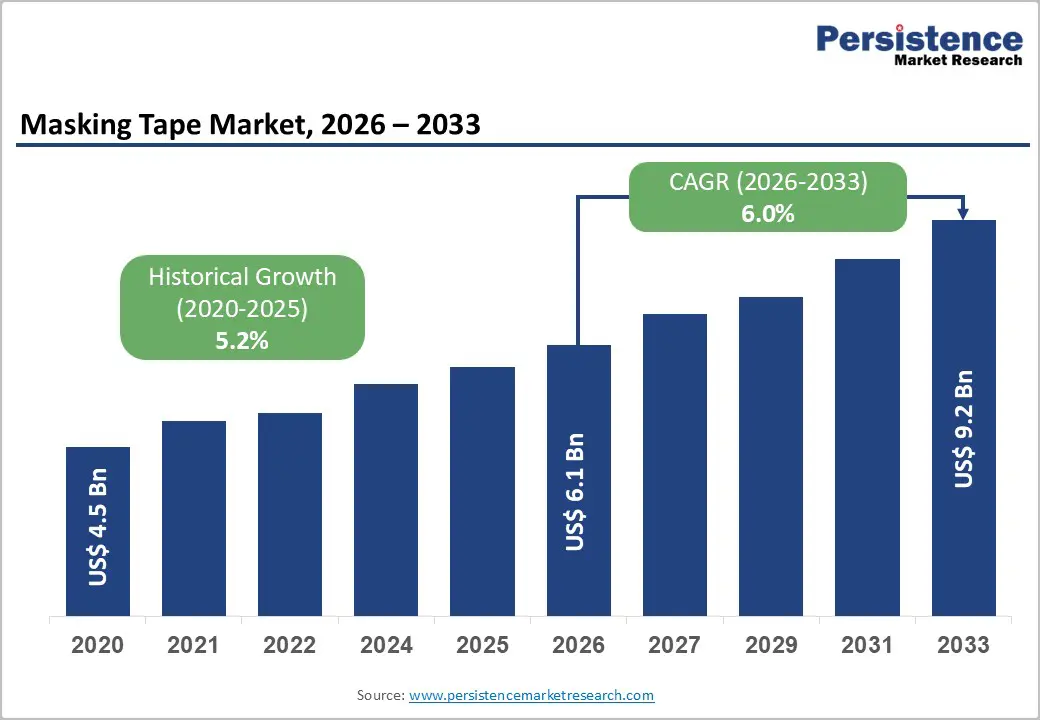
The global masking tape market size is likely to be valued at US$6.1 billion in 2026, and is expected to reach US$9.2 billion by 2033, growing at a CAGR of 6.0% during the forecast period from 2026 to 2033. Paper masking tapes continue to dominate due to their affordability and wide industrial usage. The automotive sector remains the leading end-use industry because of increasing repainting and maintenance activities worldwide. Asia Pacific is expected to remain the leading regional market owing to strong manufacturing growth, rapid urbanization, and increasing construction projects in China, India, Japan, and South Korea. Rising demand for decorative paints and industrial coatings is also supporting regional market expansion.
Want Market Insights? Get Your Free Report Sample : https://www.persistencemarketresearch.com/samples/34423
Key Highlights from the Report
➤ The global masking tape market is projected to grow from US$6.1 billion in 2026 to US$9.2 billion by 2033 at a CAGR of 6.0%.
➤ Increasing automotive refinishing and industrial painting activities are driving market demand globally.
➤ Asia Pacific dominates the masking tape market due to rapid industrialization and construction growth.
➤ Paper masking tapes remain the leading product segment because of easy application and cost efficiency.
➤ Technological advancements in adhesive materials are improving product performance and durability.
➤ Growing infrastructure projects and renovation activities are supporting long-term market growth.
Market Segmentation
The masking tape market is segmented based on product type, adhesive type, application, and end-use industry. Paper masking tapes account for a significant market share because of their flexibility and wide usage in painting applications. High-temperature masking tapes are witnessing increasing demand in automotive and electronics industries. Rubber-based adhesives remain highly preferred for strong bonding performance, while acrylic adhesives are gaining traction due to weather resistance and long-lasting durability. Specialty masking tapes are also being increasingly adopted for industrial precision applications.
Based on end-use industry, the automotive sector dominates the market due to increasing vehicle production and repair operations. Construction and infrastructure development activities are also driving substantial demand for masking tapes in painting and surface protection applications. The electronics industry is emerging as a strong consumer because of growing semiconductor and electrical equipment manufacturing activities. Packaging and logistics sectors are increasingly adopting masking tapes for labeling and bundling applications. DIY home renovation projects are additionally supporting retail product demand worldwide.
Regional Insights
Asia Pacific leads the global masking tape market due to strong industrial development and increasing automotive manufacturing activities. China and India are major contributors because of expanding infrastructure investments and rising construction operations. The region also benefits from low-cost manufacturing capabilities and growing demand for industrial coatings and paints. Increasing electronics production activities are further supporting masking tape consumption across Asia Pacific.
North America and Europe are also important markets due to rising renovation projects and technological advancements in adhesive products. In North America, increasing automotive repair and industrial manufacturing activities are supporting demand growth. Europe is witnessing growing adoption of environmentally sustainable masking tapes because of strict environmental regulations. Latin America and the Middle East are gradually emerging as promising markets due to increasing industrialization and infrastructure expansion projects.
Customize This Report for Your Exact Requirements : https://www.persistencemarketresearch.com/request-customization/34423
Market Drivers
The growing automotive refinishing industry is a major driver supporting masking tape demand globally. Automotive manufacturers and repair centers extensively use masking tapes during painting and coating operations to achieve precise finishing and surface protection. Rising vehicle ownership and increasing accident repair activities are positively influencing market growth. Rapid industrialization and expanding manufacturing facilities are also increasing the need for efficient adhesive solutions.
Another important driver is the growing construction sector worldwide. Infrastructure development projects and residential renovation activities are increasing demand for masking tapes in painting and finishing applications. Advancements in adhesive technologies are enabling manufacturers to develop high-performance tapes with improved heat resistance and residue-free removal features. Increasing demand for eco-friendly and recyclable products is also encouraging product innovation.
Market Restraints
Fluctuating raw material prices remain a major challenge for masking tape manufacturers. Variations in the costs of paper, rubber, and adhesive chemicals directly impact production expenses and profitability. Environmental concerns associated with adhesive chemicals and non-biodegradable materials are also creating regulatory pressures for manufacturers globally.
Intense competition from alternative adhesive products and low-cost regional manufacturers may limit profit margins. Certain industries are shifting toward reusable protective films and advanced coating methods, which may reduce dependence on masking tapes in some applications.
Unlock Complete Insights – Buy the Full Report : https://www.persistencemarketresearch.com/checkout/34423
Market Opportunities
The growing focus on sustainable and biodegradable adhesive products presents strong growth opportunities for masking tape manufacturers. Companies are increasingly investing in eco-friendly backing materials and solvent-free adhesive technologies to meet changing environmental regulations and consumer preferences. The rise of green construction practices is also expected to create additional demand for recyclable masking tapes.
Expanding electronics manufacturing and renewable energy sectors are opening new business opportunities for advanced masking tape products. Increasing industrialization in emerging economies and the growing popularity of DIY renovation projects are likely to support future market expansion globally.
Company Insights
Key players operating in the masking tape market include 3M Company, Tesa SE, Nitto Denko Corporation, Avery Dennison Corporation, Intertape Polymer Group, Scapa Group plc, Shurtape Technologies LLC, and Berry Global Inc.
Foodservice Paper Bags Market
High Barrier Packaging Films Market
Persistence Market Research
Persistence Market Research Pvt Ltd
+1 646-878-6329
email us here
Visit us on social media:
LinkedIn
Instagram
Facebook
YouTube
X
Legal Disclaimer:
EIN Presswire provides this news content "as is" without warranty of any kind. We do not accept any responsibility or liability for the accuracy, content, images, videos, licenses, completeness, legality, or reliability of the information contained in this article. If you have any complaints or copyright issues related to this article, kindly contact the author above.
